Every business from a small store in South Mumbai to a large company runs on numbers. But have you ever wondered how …
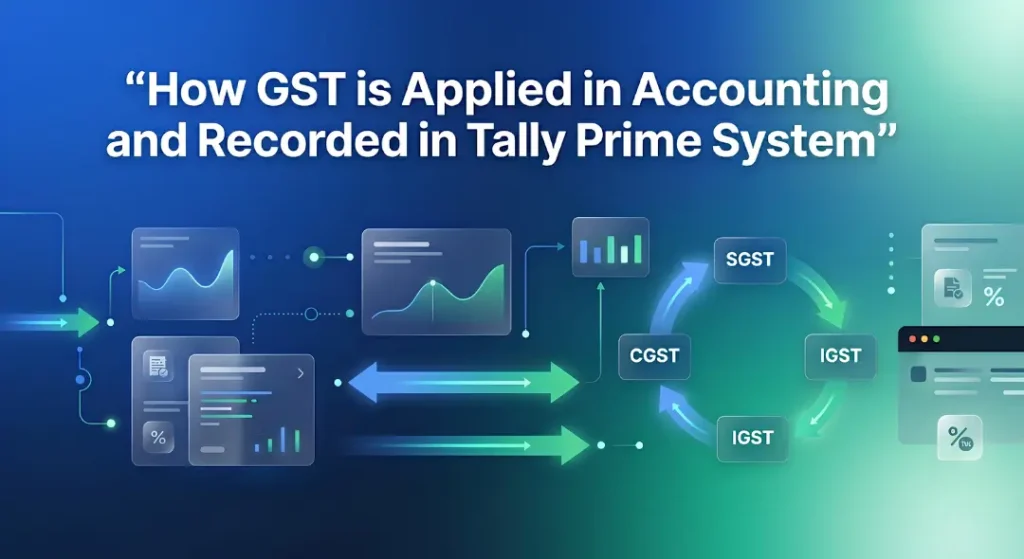
Hey everyone! If you have ever walked into a shop in Mumbai, bought a laptop, or even ordered food online, you have probably seen those three letters on your bill: GST.
For many students and small business owners, GST sounds like something very complicated. Honestly, it really isn’t. Once you understand the logic behind it, especially from purchase to sale, it becomes very practical and simple.
Today, let’s understand how Goods and Services Tax (GST) works in accounting and how businesses manage everything smoothly using Tally Prime with GST.

What is GST? Let’s Understand it Simply
Before jumping into accounting, we need to clear one basic question: what is GST?
GST (Goods and Services Tax) is a single indirect tax introduced in India in 2017. Before GST, businesses had to deal with multiple taxes like VAT, service tax, excise duty, etc. It was confusing and complicated.
Now, everything is simplified into one system.
GST in simple words:
- It is a tax on goods and services
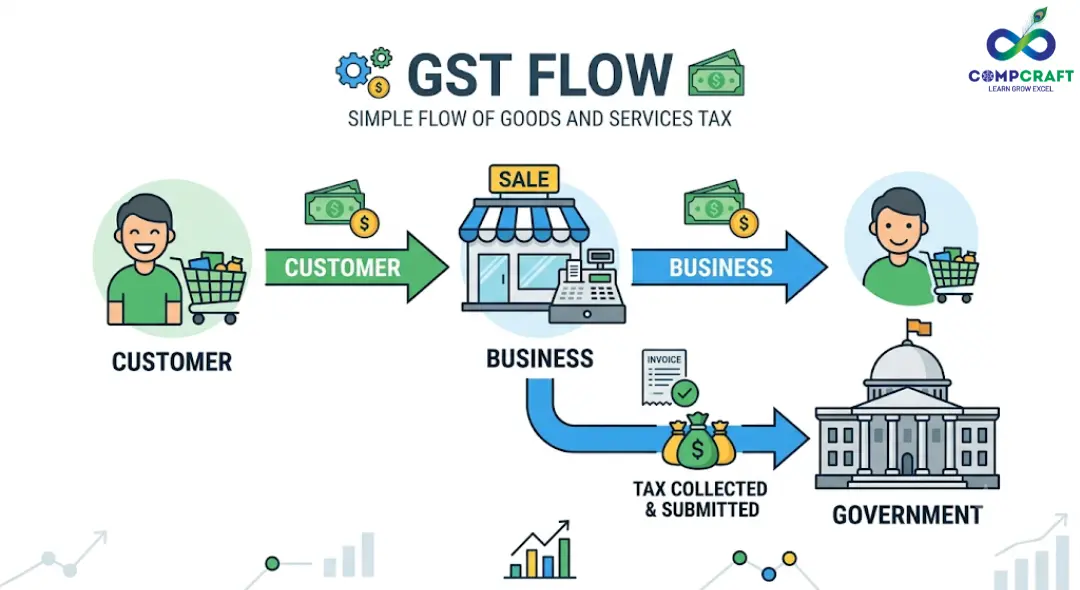
- The end consumer pays for it
- Businesses collect and pass it to the government
So basically, businesses act like middlemen between customers and the government.
CGST, SGST and IGST Meaning (Very Important)
When you look at any GST bill, you will see three main components:
1. CGST and SGST (Intra-State Transactions)
If a transaction happens within the same state (for example, Mumbai to Pune), GST is split into:
- CGST (Central GST)
- SGST (State GST)
Both are shared between the central and state governments.
2. IGST (Inter-State Transactions)
If goods move from one state to another (Mumbai to Delhi), then:
- Only IGST (Integrated GST) is applied
This is collected by the central government and later distributed.
Understanding this is very important in TallyPrime with GST accounting.
GST in Accounting: Input Tax and Output Tax
Now, let’s come to the real accounting part.
GST in accounting is mainly based on two concepts:
1. Input Tax Credit (ITC)
When you purchase goods, you pay GST on them. This is called input tax.
Good news? You can claim it back later.
This is called Input Tax Credit (ITC).
2. Output Tax
When you sell goods, you collect GST from customers. This is called output tax.
But this money does NOT belong to you. You have to pass it to the government.
Final GST Calculation:
Output GST – Input GST = Final Tax Payable
Example:
- Output GST = ₹10,000
- Input GST = ₹7,000
- Final GST payable = ₹3,000
This is the basic GST accounting treatment used everywhere.
How GST Works in India (Practical View)
In real business life, GST works like a cycle:
- You buy goods → pay GST
- You sell goods → collect GST
- You adjust both using ITC
- You pay the remaining tax
This entire flow is what we manage in TallyPrime with GST.
GST Setup in TallyPrime (Step-by-Step)
Before entering transactions, GST must be enabled.
How to enable GST in TallyPrime:
- Open a company in Tally Prime
- Press F11 (Features)
- Go to Taxation settings
- Enable GST option
- Enter GSTIN and state details
- Save using Ctrl + A
This is the basic TallyPrime GST setup process.
Creating GST Ledgers in TallyPrime
To record entries, you need proper ledgers:
- Purchase Ledger
- Sales Ledger
- CGST Ledger
- SGST Ledger
- IGST Ledger
Without this, GST entries will not work properly in TallyPrime with GST.
GST Entry in Tally Prime (Purchase Example)
Let’s understand with a simple example.
You buy goods worth ₹20,000 with 18% GST.
Steps:
- Go to F9 Purchase Voucher
- Select supplier
- Enter item details
- Add CGST and SGST ledgers
- Save voucher
Tally automatically calculates tax and updates the input GST.
This is a standard GST purchase entry in Tally Prime.
GST Sales Entry in TallyPrime (Output Tax Example)
Now, let’s say you sell goods worth ₹30,000 + GST.
Steps:
- Press F8 Sales Voucher
- Select customer
- Enter item details
- Apply CGST/SGST or IGST
- Save voucher
Tally updates the output tax automatically.

This is a GST sales entry in Tally Prime.
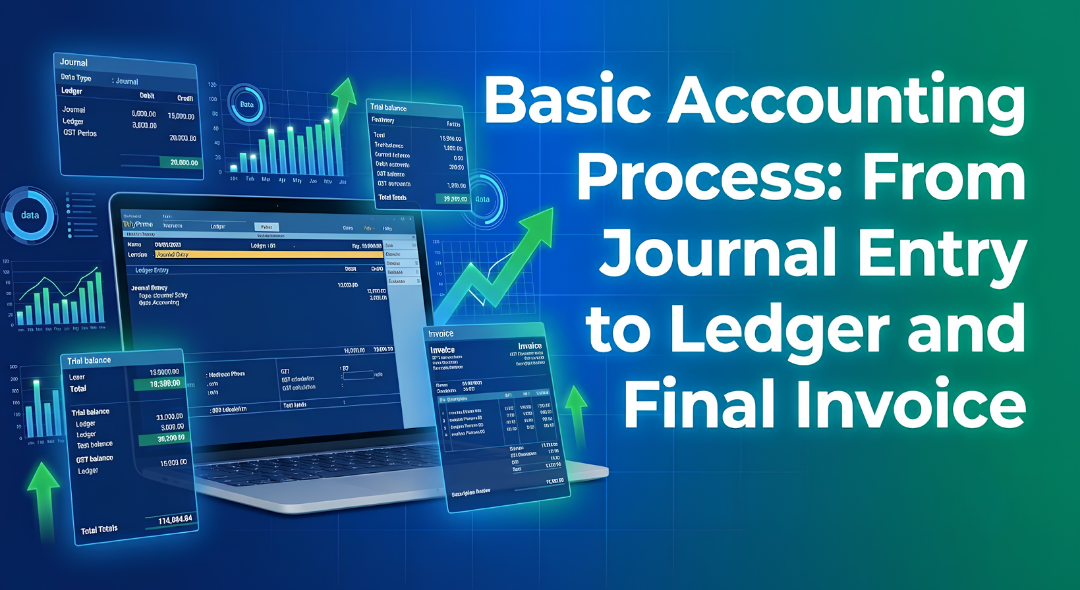
GST Journal Entry in Accounting
Before software, GST was recorded manually using journal entries:
- Purchase: Input GST Dr. / Credit Supplier
- Sales: Customer Dr. / Output GST Credit
This is called gst journal entry in accounting.
Now TallyPrime with GST automates everything.
GST Invoice Format (Basic Idea)
A GST invoice usually includes:
- Seller details
- Buyer details
- GSTIN numbers
- Item description
- Tax breakup (CGST, SGST, IGST)
- Total amount
This helps in gst return filing basics later.
GST Return Filing Basics
Every business must file GST returns monthly or quarterly.
Main returns include:
- GSTR-1 (Sales data)
- GSTR-3B (Tax summary)
In Tally Prime with GST, these reports are generated automatically based on entries.
Why Tally Prime with GST is Important
In real business, manual calculation is not practical.
That’s why TallyPrime with GST is widely used.
It helps in:
- Automatic tax calculation
- Accurate ledger updates
- Easy return preparation
- Reducing human errors
Learning GST with Proper Training
If you are serious about accounting, just reading is not enough. You need practice.
Many students search for:
- TallyPrime GST Course
- GST accounting course near me
- TallyPrime course with GST
- TallyPrime classes in South Mumbai
In Mumbai, especially around Charni Road and Opera House, many learners join structured programs like TallyPrime with GST course in Charni Road to get hands-on training.
Institutes like CompCraft also provide practical exposure using real business examples.
Final Thoughts
GST is not difficult once you understand the flow.
It is simply:
- Collect tax on sales
- Pay tax on purchases
- Adjust difference
And with Tally Prime with GST, everything becomes systematic and automated.
If you practice regularly and understand the logic behind entries, accounting becomes much easier than it looks at first.
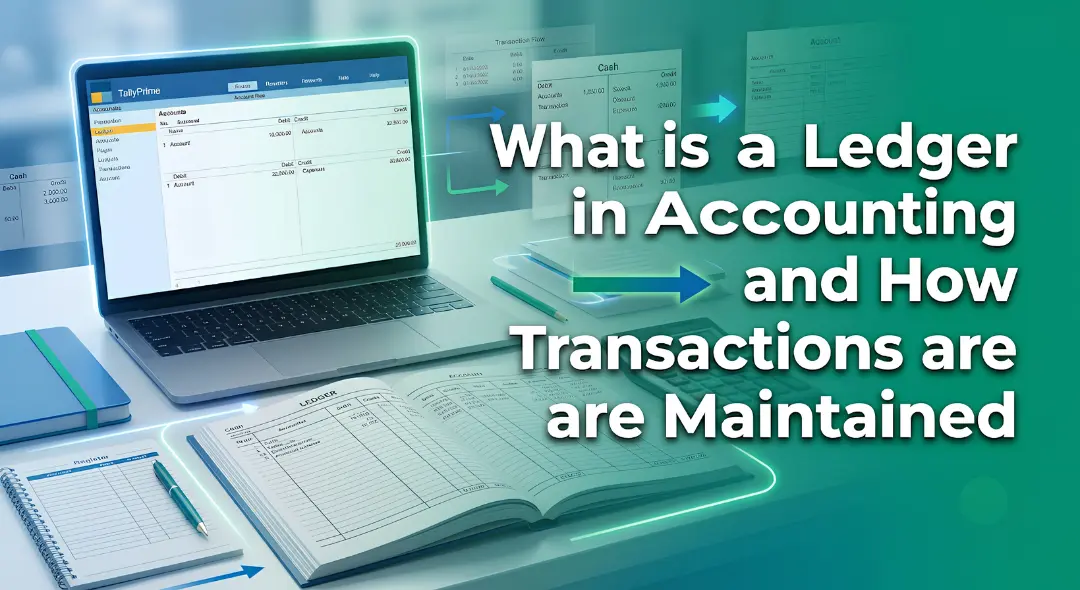
If you are new to business or managing accounts in Mumbai, you have probably heard the term ledger quite often. It sounds …
Introduction Have you ever bought a smartphone from an electronics shop and received a printed paper showing the amount you paid along …

Introduction: The Hidden World Behind Your Screen If you pick up your phone right now, what is the first app you will …

Every morning most of us in Mumbai wake up and instinctively reach for our phones. We check WhatsApp scroll through train updates …

Every week at our center I get the exact same question from students. They walk in look at the course list and …

Have you ever wondered what happens behind the scenes of your apps like Instagram, Spotify, or Netflix? Every time you scroll through …
If you want to get into the data analytics field or if you want to improve your skills you probably have a …
Imagine you are sitting in a boardroom or staring at a laptop screen looking at a spreadsheet with 10,000 rows of raw …

If you have spent any time on Instagram, LinkedIn or any other new platform that has come up, you have probably noticed …

Think about the last time you asked someone for directions and ended up completely lost. It wasn’t because they didn’t know the …

Have you ever wondered why your phone can instantly unlock by looking at your face while a traditional computer program still struggles …

Imagine you want to hire a chef for your fancy restaurant.. Instead of hiring someone who already knows how to cook you …
The interview is going well until the hiring manager slides a laptop across the mahogany desk. “Here is a raw export of …
Have you ever spent three hours building a report only for it to completely break because you inserted a single new column?. …
A Pivot Table in Excel is a tool to analyze data. It is 5:30 PM on a Friday. Your manager comes to …

Imagine you have just opened a high-end boutique in the bustling lanes of South Mumbai. You have the inventory, and the decor …

Have you ever been sitting at a cafe near Marine Lines chatting with a friend about needing a new laptop only to …

Data is everywhere. Numbers and columns do not tell a story on their own. If you have ever tried to share a …